The principles of Environmental, Social, and Governance (ESG) have emerged as a central framework guiding responsible business conduct and leading to sustainable economic development.
Across Europe, and the rest of the world, organisations of all sizes are increasingly expected by their stakeholders to demonstrate not only their financial performance but also responsible management approaches related to their environmental impact, their relationship with society, and their governance practices.
While initially ESG reporting and sustainability activities were associated with large corporations, the influence of ESG has been extending across entire value chains, directly affecting small and medium-sized enterprises (SMEs).
For SMEs, ESG can be both a challenge and an opportunity. While responding to ESG expectations from customers, financial institutions, investors, and regulators creates a burden, adopting ESG practices can help SMEs improve then operational efficiency, strengthen their resilience, and enhance their competitiveness.
What exactly is ESG
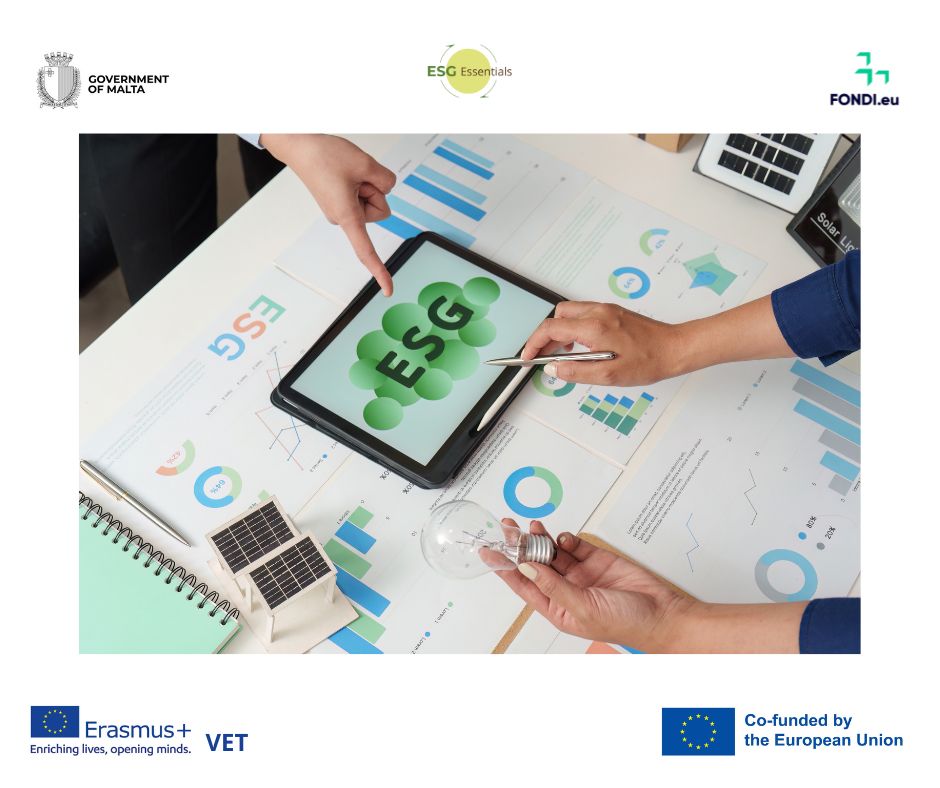
ESG refers to three pillars that evaluate how an organisation manages its responsibilities towards the environment, society, and its own governance.
Together, these three pillars provide a comprehensive approach to sustainable and responsible business management.
Why ESG matters for SMEs
SMEs represent more than 99% of businesses in the European Union and play a critical role in achieving the sustainability objectives. SMEs are expected to align with ESG principles as a result of European policies and regulations such as the European Green Deal, the EU Sustainable Finance framework, and reporting standards like the European Sustainability Reporting Standard (ESRS).
Even where SMEs are not defined as “regulated entities”, they are often indirectly affected through requirements in their supply chain, procurement practices of clients and associates, and for gaining access to finance. Larger companies, served by SMEs, frequently request ESG-related information, and in the financial sector, banking institutions and investors are increasingly considering sustainability criteria when making financing and investment decisions.
At the same time, SMEs face structural barriers to ESG implementation, including limited expertise, lack of personnel and resources, and uncertainty about where to begin with existing ESG frameworks perceived as complex and designed primarily for large organisations.
As a result, SMEs struggle to move from ESG awareness to practical implementation that will also benefit their organisations not simply help them tick a box.
The ESG Essentials initiative
The ESG Essentials project, co-funded under the Erasmus+ programme of the European Union, aims to address these challenges by supporting SMEs and micro-enterprises understand and implement ESG principles in a practical way.
The project brings together a consortium of European partners that have joined forces to develop training resources and tools, and implementation frameworks tailored to the needs of SMEs and micro-enterprises. Rather than focusing on the reporting side, the project emphasises the development of skills, knowledge, and practical guidance that can enable businesses to integrate ESG considerations into their daily operations.
A key project outcome is the ESG Essentials Implementation Framework, which provides SMEs with a structured methodology and specific phases for adopting ESG practices. The framework guides organisations through the phases that can support them transition from training to awareness, assessment, strategy development, implementation, and monitoring.
The training curriculum that will be hosted on the digital learning platform will allow business owners, professionals, trainers, and SME managers to develop the competencies required to understand and apply ESG principles in their organisations.
Driving the Sustainability transition
The transition toward sustainable and responsible business practices is one of the defining economic and societal transformations of our time. The Circular Economy, due for adoption in 2026, demonstrates the European Union’s commitment to sustainability and for transitioning to a circular economy for a cleaner and more competitive Europe (https://environment.ec.europa.eu/strategy/circular-economy_en).
For SMEs, navigating this transition requires practical tools, guidance, and relevant training.
By focusing on capacity building and practical implementation, the ESG Essentials project aspires to empower SMEs to adopt ESG practices in ways that are proportionate to their size and resources and that will actually benefit them.
The project will support SMEs to avoid approaching ESG as a regulatory burden, and begin to see sustainability as a strategic opportunity that will support them strengthen competitiveness, improve risk management, and support their long-term business success.
Initiatives such as ESG Essentials can play an important role in ensuring the sustainability transition is inclusive, by enabling businesses of all sizes to participate in building a more resilient and responsible European economy and society.